
When Is a Full House Rewire Better Than Ongoing Electrical Repairs?
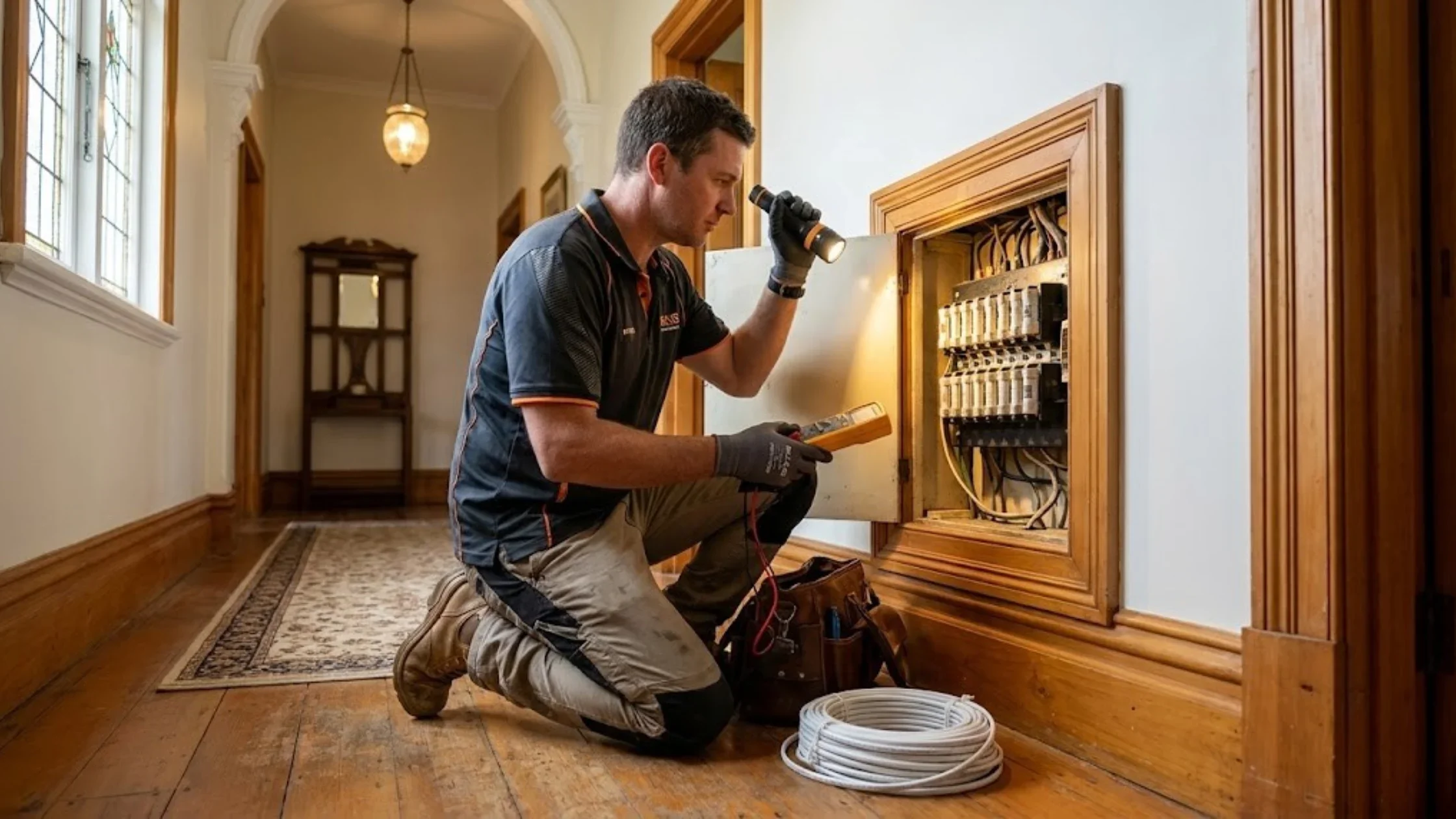
Your lights flicker again. You reset the same breaker for the third time this month. You ring an electrician, pay the call-out fee, get a temporary fix, and quietly wonder if this is just what owning an older home feels like now. It isn't. If you're patching the same wiring problem over and over, you're not being careful with money — you're often spending more than a rewire would have cost, while your risk keeps climbing.
The Quick Answer
A single repair is usually the right call when a fault is new, isolated, and your wiring is otherwise sound. A full house rewire becomes the smarter choice once your wiring is over 30 years old, faults keep returning in different rooms, your insurer starts asking questions about your cabling, or you're already opening up walls for a renovation. Once you've paid for three or four separate call-outs, you've often spent close to a third of what a full rewire would have cost — without actually fixing the underlying problem.
Key Takeaways
A repair fixes today's fault; a rewire fixes the reason faults keep happening.
Three or four repeat call-outs on old wiring often cost close to what a rewire would have cost outright.
Homes older than 30 years, or with TRS/VIR cabling, are the ones insurers watch most closely.
A Certificate of Compliance from a rewire can support your insurance cover and boost your home's resale value.
Rewiring while your walls are already open for a renovation is almost always the cheapest time to do it.
A proper on-site inspection beats guessing — it tells you honestly whether you need a repair or a rewire.
What "Rewiring" Actually Means, and Why the Decision Matters
A full house rewire means replacing all the electrical cabling in your home, from the switchboard through to every power point, light switch, and fitting. It's different from a repair, which only fixes the one fault in front of the electrician that day. Both jobs keep your home powered. Only one of them stops the same fault from coming back next winter.
This matters because old wiring doesn't fail neatly. A fault in your kitchen today can be a symptom of tired insulation running through your entire ceiling. Repairing the visible symptom might get your lights back on this afternoon, but it doesn't tell you what's happening behind the wall in your bedroom, or under your floor near the hot water cylinder. That's the real question this guide answers: at what point do repeated repairs stop being the cheaper option, and a full house rewire start making more financial and practical sense.
The Real Cost of "Just One More Repair"
Here's the part most homeowners never sit down and calculate. Each electrician call-out for a fault involves a travel fee, diagnostic time, and parts — and in Nelson Tasman, that typically lands somewhere between $150 and $450 per visit, depending on how tricky the fault is to trace. On its own, that feels manageable. The trouble starts when it happens again three months later, in a different part of the house.
Old wiring tends to fail in stages, not all at once. A rubber-insulated cable that's cracked near the switchboard is often just as brittle everywhere else it runs — it's simply had less stress applied to it yet. So you fix the fault in the hallway this year, the kitchen circuit trips next winter, and the bathroom light starts flickering the year after that. Each repair is reasonable on its own. Added together, they quietly become expensive.

The numbers above are general New Zealand ranges for 2026 and will vary depending on your home's age, size, and how accessible your roof and subfloor are — an electrical inspection is the only way to get a figure specific to your property. But the pattern holds true across most older homes: once you've paid for your third or fourth repair on ageing wiring, you've usually spent close to what a switchboard upgrade or partial rewire would have cost, and you still haven't solved the actual problem.
Is Your Wiring Actually a Safety Risk?
Cost is only half the story. The other half is what's happening behind your walls while you're deciding what to do. Homes built before 1970, and many built before 1990, often used rubber or fabric-coated cabling that simply wasn't designed to last this long. Over decades, that insulation dries out, cracks, and becomes brittle. It doesn't announce itself with a warning light. It shows up as small, easy-to-dismiss signs.
Flickering lights when you switch on the kettle, a breaker that trips for no obvious reason, power points that feel warm to the touch, or a faint burning smell near a switchboard are all worth taking seriously. So is finding black rubber or cloth-covered wiring if you ever peek into your roof space. None of these are emergencies on their own. Together, or repeated over time, they're your home telling you that the wiring underneath is ageing faster than the walls around it. If you're seeing any of these signs right now, it's worth booking a proper look rather than waiting — our emergency electrician team can talk you through what's urgent and what can wait for a planned rewire.
The reassuring part is that this isn't a DIY problem to solve, and it isn't one you have to solve alone. In New Zealand, this kind of work legally has to be carried out by a registered electrician, which protects you both physically and legally. A properly rewired home, finished with a Certificate of Compliance, gives you documented proof that everything meets current New Zealand wiring standards — proof that matters far beyond just flicking a switch and having the light come on.
How Old Wiring Affects Your Home Insurance
This is the part many Nelson Tasman homeowners don't find out until it's too late. Insurance companies have become noticeably more cautious about older wiring types, particularly TRS (tough rubber sheath) and VIR (vulcanised Indian rubber) cabling, both common in homes built before the 1960s and 70s. Some insurers now charge a higher premium for homes still running this cabling. Others will decline fire cover altogether until it's replaced.
It's a quiet risk because nothing changes on the surface. Your policy still exists, your premium still gets paid, and everything feels fine — right up until you make a claim and discover a clause you never noticed. A full rewire, finished with a Certificate of Compliance, gives your insurer clear, dated proof that your home's wiring meets current standards. For a lot of homeowners, that single document ends up being worth more than the rewire itself, simply because of the peace of mind it buys back.
It's also worth thinking about ahead of a house sale. Buyers, and their lawyers, increasingly ask about the age and condition of a property's wiring during due diligence. Being able to hand over a recent Certificate of Compliance is a genuinely useful selling point, not just a compliance formality.
Renovation Timing: Why "While the Walls Are Open" Changes Everything
If you're planning a kitchen or bathroom renovation, or any project that involves opening up walls or ceilings, this is the single biggest factor in the rewire-versus-repair decision. Once a wall is opened for plumbing, insulation, or new cabinetry, running new cabling through it costs a fraction of what it would to open that same wall again in a few years, purely for electrical access.
Rewiring Before a Renovation
Doing your rewire before tiles go down or cabinetry goes in means your electrician can plan power point positions, lighting circuits, and any new appliance loads around the finished design, rather than working around it. This is especially relevant for kitchens and bathrooms, where modern appliances, extractor fans, and heated towel rails all draw more power than older circuits were ever designed to handle. If a renovation is already on your calendar, our kitchen and bathroom electrical upgrade team can walk through timing with you before the builders start.
Rewiring During a Wider Renovation
For a larger renovation, rewiring alongside your builder's schedule means one round of wall repairs and repainting, instead of two. It also avoids the frustrating scenario where a freshly renovated room has to be reopened eighteen months later because a fault turns up in wiring nobody thought to replace at the time. Our renovation electrical services team coordinates directly with builders across Nelson and Tasman to keep this part of the project simple rather than stressful.
If a renovation isn't on the cards yet, that doesn't mean rewiring has to wait. A standalone full rewire is still very achievable, and a good electrician will work room by room so you're not left without power while it's underway.

The Long-Term Value of Rewiring Your Home
Beyond safety and insurance, a full rewire quietly pays you back in ways that are easy to overlook. Your home's electrical capacity increases, which matters more each year as households add heat pumps, EV chargers, induction cooktops, and more devices than a 1960s switchboard was ever built to handle. Modern circuits also run more efficiently, which can shave a little off your power bill over time, particularly if outdated wiring was causing voltage drop or overloaded circuits.
There's a property value angle too. A documented, recent rewire is a genuine selling point, particularly for character villas and older bungalows across areas like The Wood, Stoke, and South Nelson, where buyers are often weighing up charm against the hidden cost of ageing infrastructure. Being able to say "fully rewired, Certificate of Compliance available" removes one of the biggest question marks a buyer's building inspector will raise. And on a more everyday level, a rewire usually means more power points exactly where you actually need them, rather than the awkward extension-cord arrangements that older homes tend to accumulate over the decades. If that's the part you're most looking forward to, our power point and outlet installation page shows what's possible once the underlying wiring is sorted.
So, Repair or Rewire? A Simple Way to Decide
If your home's wiring is under 20 years old and a fault is genuinely a one-off, a straightforward repair is almost always the right, proportionate answer, and there's no need to rush into anything bigger. The picture changes once your home is older than 30 years, faults have shown up more than twice in different parts of the house, your insurer has raised questions about your cabling, or you're already planning a renovation that will open up your walls anyway. In any of those situations, an honest inspection is worth far more than another guess over the phone. A qualified electrician can look at your actual switchboard and cabling, tell you plainly whether you're dealing with an isolated fault or a wider pattern, and give you a fixed quote based on what they find rather than what a website estimate suggests.
Ready for a Straight Answer About Your Wiring?
You don't need to work this out alone, and you shouldn't have to guess based on how many times you've reset a breaker this year. Jordan Inwood and the team at Mako Electrical have spent years working on homes right across Nelson, Richmond, Motueka, and the wider Tasman region, from original villas in The Wood to newer builds in Stoke. That local, hands-on experience means we can usually tell you within a single visit whether you're looking at a simple repair or a case for a full rewire, backed by a clear, honest quote rather than an upsell.
Get in touch with Mako Electrical today to book a wiring assessment, or explore our full house rewiring services in Nelson and Tasman to see exactly what's included. If you'd like to compare rewiring against a smaller electrical upgrade first, our related guide on rewiring versus an electrical upgrade is a useful next read.
Conclusion
There's no single rule that fits every home, but there is a clear pattern. If a fault is new and isolated, a repair is sensible and proportionate. If you're on your third or fourth repair, your wiring is older than 30 years, or your insurer has started asking questions, a full house rewire usually costs less than you'd expect once you weigh it against ongoing repairs, and it comes with safety and insurance benefits a repair simply can't match. The best next step isn't to decide from a blog post — it's to get an honest, on-site opinion from someone who'll tell you what your home actually needs. Mako Electrical is based right here in Nelson Tasman, and a wiring assessment is a simple, no-pressure way to finally get a straight answer.
Frequently Asked Questions
-
If a fault is new, isolated to one area, and your home's wiring is under 20 to 30 years old, a repair is usually enough. If faults keep returning in different rooms, or your home is older with original cabling, a full rewire is typically the safer, more cost-effective long-term option.
-
A standard three-bedroom home typically costs between $8,000 and $15,000 to rewire fully, while larger or two-storey homes can run from $16,000 to $25,000 or more. Your exact price depends on your home's size, age, and how accessible the roof and subfloor are.
-
A single repair is cheaper upfront, but repeated repairs on ageing wiring add up quickly. After three or four call-outs, many homeowners have spent close to a third of a full rewire's cost without actually fixing the underlying problem.
-
It can. Many New Zealand insurers charge higher premiums, or refuse fire cover, for homes with old TRS or VIR cabling. A rewire with a Certificate of Compliance shows your insurer the wiring meets current standards, which can help lower your premium.
-
Most full rewires in Nelson Tasman take between five and ten working days, depending on your home's size and how easy it is to access the roof and subfloor. Two-storey or heritage villas with restricted access can take a little longer.
-
Yes, in most cases. A good electrician will work through your home room by room, so you're not left without power for long stretches. You should expect some noise, dust, and short power interruptions during the day.
-
Watch for flickering lights, breakers that trip repeatedly, warm power points, a faint burning smell near switches, or black rubber or fabric-covered wiring visible in your ceiling. Any of these are worth a proper inspection.
-
Rewiring while walls are already open for a renovation is almost always cheaper and less disruptive, since your electrician avoids reopening finished walls later. If you're planning a renovation, it's worth scheduling the rewire first.
-
Rewiring itself usually doesn't need building consent, but the work must be carried out by an EWRB-registered electrician who issues a Certificate of Compliance. This certificate is what your insurer and any future buyer will want to see.
-
A partial rewire replaces only the circuits or areas with confirmed faults, leaving sound wiring in place. A full rewire replaces everything from the switchboard outward. Partial rewiring suits localised problems; full rewiring suits homes with uniformly old or deteriorating cabling.
