
When to Schedule Your Electrician During Renovation: A Stage-by-Stage Breakdown

Knowing when to schedule your electrician during renovation is simpler than most homeowners expect: bring them in before construction starts, and again at two key stages once framing begins. Get the timing wrong and you are looking at opened walls, blown budgets, and delays that ripple across every other trade on site.
Renovations in Nelson are rarely straightforward. Between council requirements, compliance certificates, and coordinating with builders, plumbers, and tilers, the electrical side of things is easy to underestimate. This article walks you through each stage of a renovation, explains exactly when your electrician needs to be on site, and shows you how to avoid the costly scheduling errors that trip up homeowners across the Nelson-Tasman region every year.
Key Takeaways
Book your electrician at the planning stage, not after framing begins. Early involvement prevents costly layout conflicts.
First fix must happen before insulation and plasterboard. Missing this window means opening walls later.
Second fix follows painting and flooring. Sequence this carefully to protect finished surfaces.
A Certificate of Compliance is legally required and essential for council sign-off and insurance.
Clear communication between your builder, electrician, and plumber prevents the most common renovation delays.
Pre-wiring for EVs, solar, and smart systems during the first fix is far cheaper than retrofitting.
Why Electrical Timing Makes or Breaks Your Renovation
Electrical work is not something you slot in whenever there is a gap in the schedule. Wiring runs behind walls, under floors, and through framing, which means the electrical phase is tightly interlocked with almost every other trade. If your electrician is not on site at the right moment, someone else either has to wait or redo their work.
The consequences of poor timing are real and measurable:
Walls get re-opened. If plasterboard goes on before wiring is roughed in, your builder has to cut it back out. That means extra labour, patching, repainting, and delays.
Appliances cannot be hardwired. Ovens, rangehoods, and heated towel rails all need dedicated circuits. If those circuits are not in before the kitchen fits out, you are stuck.
Switchboard upgrades get missed. Older Nelson homes often run on outdated boards that cannot handle modern loads. Discovering this after fit-out is an expensive surprise.
Compliance gets complicated. Your electrician must issue a Certificate of Compliance (CoC) before the council grants code compliance. A rushed or out-of-sequence install makes this harder to achieve cleanly.
To understand the full picture of what goes wrong when electrical work is rushed or out of order, it is worth reading this breakdown of electrical renovation mistakes nz that commonly affect Nelson homeowners.

The Four Stages: When to Schedule Your Electrician During Renovation
Most residential renovations move through four distinct phases where electrical input is needed. Missing any one of them creates problems downstream.
Stage 1: Planning and Design (Before a Single Nail Goes In)
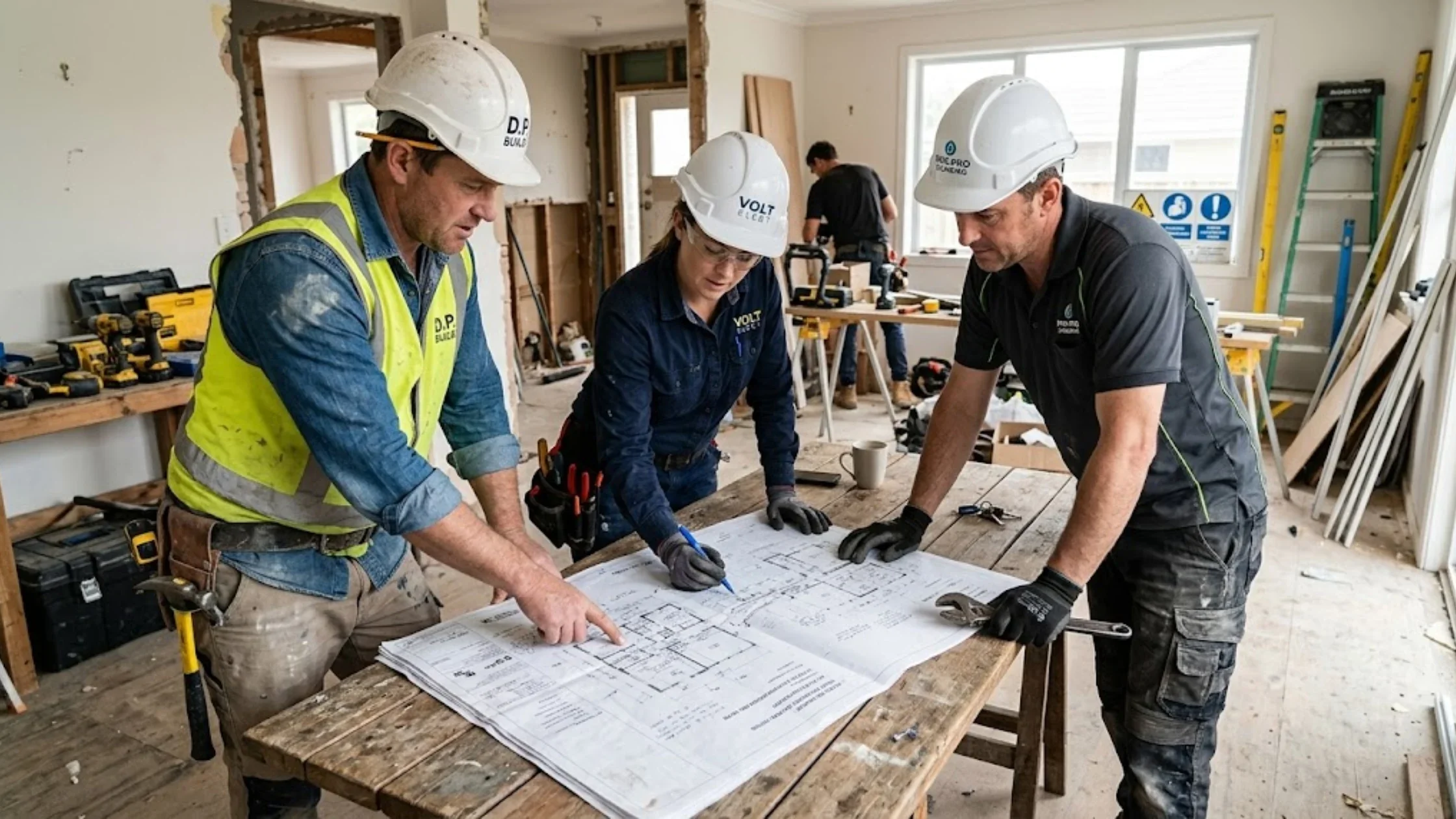
This is the stage most homeowners skip, and it is arguably the most valuable. Before construction starts, your electrician should be sitting at the table alongside your architect or builder, reviewing the floor plan and identifying:
Where power points should go based on your furniture layout and appliance use
How lighting circuits will be zoned and whether dimming is required
Whether your existing switchboard can handle the new load
Pre-wiring requirements for EV chargers, solar panels, heat pumps, or home automation
Any structural elements, like beams or load-bearing walls, that could affect cable routing
Getting this input early means your builder frames around the electrical plan rather than the other way around. It also means fewer surprises when you get to the physical work. If you are still at the design phase, a solid electrical plan for house nz is a practical place to start before your first site meeting.
Stage 2: First Fix (Walls Are Open, Before Insulation or Plasterboard)
First fix is the most time-sensitive stage of any renovation. This is when your electrician installs everything that lives inside the walls and ceiling cavities:
All cabling and wiring runs
Back boxes for switches and power points
Distribution board positioning or upgrades
Conduit for data, alarm, and network cables
Any pre-wiring for future systems
The window for first fix is short. Once insulation goes in and plasterboard follows, the opportunity closes. Coordinate with your builder to ensure the electrician is booked and confirmed before framing is complete. A two-day delay in booking can push your entire project timeline out by a week or more.
This is also the stage where communication between trades matters most. If your plumber and electrician are both working in the same wall cavities, someone needs to manage that sequence. Typically this falls to your builder, but it pays to confirm it explicitly.
For Nelson and Tasman homeowners, renovation electrical work nelson tasman covers what to expect from a local electrician during this phase.
Stage 3: Second Fix (After Painting and Flooring Are Complete)
Second fix is when the renovation starts to look finished. Once paint is dry, tiles are laid, and flooring is down, your electrician returns to install:
Power point and switch face plates
Light fittings and downlights
Hardwired appliances (ovens, rangehoods, bathroom heaters)
Smoke alarms and security systems
Final connections to the switchboard
The sequencing here matters for practical reasons. Installing light fittings before the ceiling is painted means protecting them from overspray. Installing power points before tiles are laid risks getting grout in places it should not be. Your electrician and builder should agree on the exact handover point before second fix begins.

Stage 4: Compliance Sign-Off and Certificate of Compliance
Every electrical job in Nelson, including renovation work, requires a Certificate of Compliance issued by a licensed electrician. This document confirms that all work meets the requirements of the Electricity (Safety) Regulations 2010 and AS/NZS 3000 wiring rules.
Without a CoC, you cannot:
Obtain a code compliance certificate from your local council
Make a valid insurance claim related to electrical faults
Sell the property without disclosing non-compliant work
Your electrician should handle this paperwork as a standard part of the job. If they do not offer it upfront, ask directly. Using a certified tradesperson removes this risk entirely. For more on why this matters, the article on why use certified electrician renovation nelson explains the legal and safety obligations in plain terms.
How to Coordinate Your Electrician With Other Trades
Your builder typically manages the overall project schedule, but homeowners who stay actively involved in trade coordination have smoother renovations. Here is a practical framework:

The most common coordination failure is the plumber and electrician both needing access to the same wall at the same time without a plan. Sort this out in your pre-construction meeting, not on the day.
Things to Know
In Nelson, all electrical work must be carried out by a registered electrician. DIY wiring, even minor work, is illegal and invalidates your home insurance.
Older Nelson homes, particularly those built before 1980, often have aluminium wiring or fuse boards that need upgrading before a renovation can proceed safely.
Pre-wiring for EV chargers and solar during first fix costs very little compared to retrofitting later. It is a decision worth making at the planning stage.
Council inspections for code compliance require a CoC from your electrician. Without it, you cannot close out your building consent.
Changing your mind about power point locations after first fix is expensive. Nail down your layout before the walls are opened.
If you are extending your home, your existing switchboard may need to be upgraded to handle the additional circuits. Budget for this possibility from the start.
Ready to Lock In Your Renovation Electrical Schedule?
The single most useful thing you can do right now is contact your electrician before your builder breaks ground. Book a planning consultation, share your floor plans, and confirm the first-fix date in the project schedule. That one conversation can save you weeks of delays and thousands of dollars in rework.
To see what this looks like in practice for Nelson and Tasman homeowners, you can explore the full range of residential electrical services nelson or get in touch with Mako Electrical directly to talk through your project timeline.
You can also learn more about Mako Electrical's experience working alongside local builders and architects across the Nelson-Tasman region.

Frequently Asked Questions
-
Contact your electrician during the planning phase, before any construction starts.
This gives them time to review your floor plan, identify power requirements, and advise on layout decisions that affect framing. Waiting until walls are up severely limits your options and almost always increases cost.
-
First fix is all the wiring that goes inside walls before they are closed; second fix is the installation of fittings and face plates after painting is done.
First fix includes cables, back boxes, and board connections. Second fix covers power points, light fittings, and hardwired appliances. Both stages require a licensed electrician and must be completed in the correct sequence.
-
Yes, a Certificate of Compliance is legally required for all electrical work carried out in Nelson.
Your electrician must issue this document upon completion of the work. It is required by your council for code compliance, by your insurer for valid cover, and by any future buyer if you sell the property.
-
Your electrician will need to upgrade the switchboard before new circuits can be added safely.
This is common in older Nelson homes. Switchboard upgrades should be identified and costed at the planning stage. Discovering the need after fit-out means additional disruption and expense. For more detail on this, the article on avoid wiring mistakes home renovation nelson covers common oversights that catch homeowners off guard.
-
Your builder typically manages the overall schedule, but the homeowner should confirm electrical staging is explicitly included in the project plan.
Do not assume your builder and electrician are communicating automatically. Confirm first-fix and second-fix dates are locked in during your pre-construction meeting, and check in at each major milestone.
The Bottom Line on When to Schedule Your Electrician During Renovation
Electrical work is not something to fit around other trades. It drives the schedule. When you bring your electrician in at the planning stage, coordinate first fix before walls close, and confirm second fix after painting, you protect your budget, your timeline, and your compliance sign-off.
The homeowners who have the smoothest renovations are the ones who treat their electrician as a core part of the project team from day one. Start the conversation early, visit to learn what Mako Electrical can offer, and lock in your electrical schedule before the builder swings the first hammer.
