
Is RCD Protection Enough to Keep Your Family Safe During Winter?

When the Power Flickers, So Does Your Peace of Mind
It's a wet Tuesday night in Nelson. The rain is hammering the roof, the heater's running flat out, and then — click — the power cuts. You check the switchboard, flip it back on, and get on with your evening. Most people assume that little switch just did its job and everything's fine now.
Here's the honest bit: it might have. Or it might have been the first sign of a bigger problem your RCD was never designed to catch. RCD protection is one of the best safety tools ever added to New Zealand homes, but it's not a complete electrical safety plan on its own — especially once winter weather starts putting extra strain on your wiring, your switchboard and every appliance plugged in to keep your family warm.
What RCD Safety Switches Do (and What They Can't Protect Against)
RCDs (safety switches) protect people from electric shock by cutting power in milliseconds if current leaks somewhere it shouldn't.
They don't protect against everything — overloaded circuits, damaged wiring, power surges from storms, and some fire risks sit outside what an RCD can catch.
Testing matters. Push the test button every six months and get a qualified electrician to properly test it every two years.
Surge protection and switchboard upgrades fill the gaps RCDs leave open, particularly in older Nelson Tasman homes.
Layered protection is the real answer — not one device doing all the work.
Key Takeaways
RCDs stop electric shock by cutting power the instant current leaks to earth — they're essential, but they only do this one job.
They don't catch power surges, overloaded circuits, some wiring faults, or damaged double-insulated appliances.
Push-test your RCD every six months and book a professional trip-time test every two years.
Winter storms in Nelson Tasman increase surge risk and put extra load on older switchboards right when families are relying on heating the most.
Whole-home surge protection and a switchboard upgrade close the gaps an RCD leaves open.
Real safety comes from layered protection, not a single device.
What Does RCD Protection Actually Do?
Let's start with the basics, because a lot of homeowners have an RCD without really knowing what it's watching for. A Residual Current Device, or RCD, is a small switch built into your switchboard that constantly compares the electricity flowing into a circuit against the electricity flowing back out.
In a healthy circuit, those two numbers should match almost exactly. The moment they don't — say, because current is leaking through a person, a wet appliance, or damaged insulation — the RCD trips and cuts the power in a fraction of a second. That speed is what saves lives. A shock that lasts a few thousandths of a second is far less likely to be fatal than one that keeps flowing.
This is why RCDs are sometimes called safety switches, and why they're now a required part of the wiring rules for New Zealand homes. If your house still doesn't have them fitted throughout, that's one of the fastest, most affordable upgrades you can make. Our team can talk you through RCD installation for Nelson homes as part of a broader safety check.
How an RCD Is Different From a Circuit Breaker
People often mix these two up, so it's worth clearing up. A standard circuit breaker protects your wiring and appliances from overheating by tripping when too much current flows through a circuit — think of it as protecting the house from an electrical fire caused by overload. An RCD protects people from electric shock by watching for current leaking to earth. A modern switchboard needs both, working side by side, not one instead of the other.
What RCD Protection Doesn't Cover
This is the part that catches families out, and it's the honest answer to the question in our title. An RCD is brilliant at one specific job. It was never designed to be your entire electrical safety net, and knowing where it stops is just as important as knowing what it does.
Overloaded Circuits and Old Wiring
If a circuit is simply carrying more load than it was built for — too many heaters, an EV charger, a full kitchen running at once — an RCD won't necessarily step in. That's a circuit breaker's job, and older switchboards often don't have breakers rated for how modern households actually use power. Wiring that's cracked, chewed by rodents, or simply worn out from decades of use can also fail in ways an RCD doesn't catch until a shock risk is already present.
Power Surges From Winter Storms
Nelson Tasman winters bring exactly the kind of weather that causes power surges: lightning strikes near the network, sudden voltage spikes when the power comes back on after an outage, and stress on the local grid during storms. An RCD does not monitor voltage spikes at all. A surge can travel straight through your switchboard and fry a heat pump, a TV, or a hot water cylinder controller while the RCD sits there doing exactly what it's meant to do — because a surge isn't the kind of fault it watches for.
Fires That Start Without an Earth Fault
Some electrical fires begin with a loose connection or overheating cable that never actually leaks current to earth. Because there's no imbalance for the RCD to detect, it won't trip, even though the risk is very real. This is one of the reasons regular electrical inspections matter as much as the safety switch itself — a trained eye can spot warning signs a device simply isn't built to see.
Faults Inside Sealed or Double-Insulated Appliances
Some appliances are designed with double insulation specifically so a fault can't reach an earth wire. That's good design in one sense, but it also means an RCD has nothing to detect if something goes wrong internally. Regular tag and testing of appliances catches problems like these long before they become dangerous.
How Often Should You Test Your RCD?
An RCD that isn't working is worse than no RCD at all, because it gives you false confidence. New Zealand guidance, based on the AS/NZS wiring and testing standards, sets out a simple routine every homeowner can follow.
Press the test button on your switchboard every six months. A handy trick is to tie it to the daylight saving clock change — when the clocks move, test your RCD. It only takes a few seconds, and if the switch doesn't trip when you press it, that's a sign it needs a professional look.
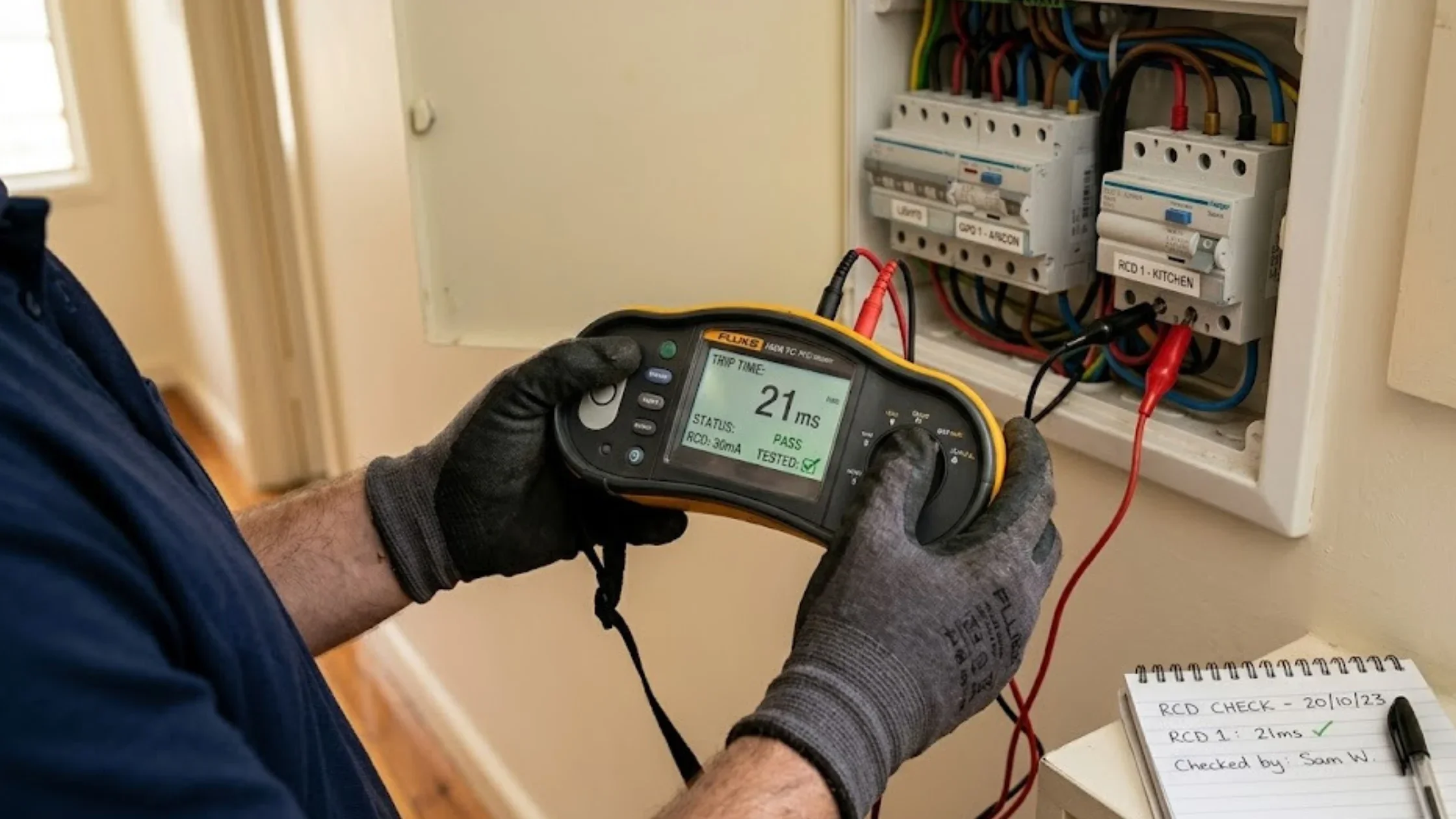
Beyond the push-button check, get a qualified electrician to carry out a proper trip-time test every two years. This measures exactly how fast the RCD actually cuts power under real fault conditions, not just whether the button works. It's a quick, affordable visit and one of the cheapest insurance policies your home can have. If you're not sure when yours was last checked, our step-by-step guide to testing an RCD walks through exactly what to look for.
Why Winter Raises the Stakes
Winter changes how your home uses electricity, and that changes the pressure on your whole system. Heaters, heat pumps, electric blankets and hot water cylinders all draw more current at exactly the time storms are more likely to cause surges and outages. Damp conditions also increase the chance of moisture finding its way into outdoor sockets, garages or older wiring, which is precisely the scenario an RCD is designed to catch — but only if it's actually working, and only if the rest of your switchboard can handle the load safely.
If your circuit breaker keeps tripping whenever it rains, that's not something to shrug off. It's usually a sign moisture is reaching wiring or a switchboard component somewhere in the system, and it's worth reading through what a rain-triggered trip is usually telling you.
Surge Protection: The Layer Your RCD Misses
Because RCDs don't watch for voltage spikes, surge protection is the piece that closes that particular gap. A whole-home surge protection device sits at your switchboard and absorbs sudden spikes before they reach your appliances, rather than relying on individual plug-in surge boards scattered around the house.
For Nelson Tasman homes with a heat pump, a hot water cylinder with electronic controls, or a house full of connected devices, this is genuinely worth the conversation. A single surge event can cost far more in appliance damage than the protection would have cost to install, and it works quietly in the background alongside your RCDs rather than replacing them.

Switchboard Upgrades: Where Everything Comes Together
Your switchboard is the hub that everything else depends on. If it's old, it may not have room for modern RCDs, surge protection, or enough circuits to safely run today's appliances. Many Nelson Tasman homes built before the 1990s still have switchboards with ceramic fuses and no safety switches fitted at all, which means the very first layer of protection is simply missing.
An upgrade brings your home in line with current standards, adds proper RCD coverage across every circuit, makes room for surge protection, and stops the frustrating cycle of tripped breakers during storms. It's also the moment to plan ahead for things like EV chargers or a renovated kitchen, so the board isn't stretched thin the moment you add something new. You can see exactly what's involved in our switchboard upgrade guide for Nelson Tasman homes.
Building a Complete Winter Safety Layer
No single device does everything, and that's the honest, useful way to think about home electrical safety. Each layer covers a gap the others leave open.

Put together, these layers give your family genuine whole-home protection rather than a false sense of security from one switch doing all the work. If you'd like an outside opinion on where your home currently stands, our six-point electrical safety check for NZ homes is a good place to start, or you can book a full electrical inspection with our Nelson Tasman team.
Ready for Whole-Home Peace of Mind This Winter?
You don't need to overhaul your whole house to close these gaps — you just need someone who knows exactly where to look. Mako Electrical has been helping Nelson Tasman families make sense of their switchboards, RCDs and surge protection for years, with straightforward advice and no pressure to buy more than you need.
If your RCD hasn't been tested recently, your switchboard still has old fuses, or your power's been tripping every time it rains, get in touch with our team. We'll check your home, explain what we find in plain English, and give you a clear, honest quote for anything that needs sorting before the next storm rolls in.
Book your electrical safety check with Mako Electrical
Your Family Deserves More Than One Layer of Protection
RCD protection is a genuine lifesaver, and every home should have it. But treating it as your only line of defence leaves real gaps open — the kind that winter storms, ageing wiring and overloaded circuits are especially good at finding. The good news is that closing those gaps doesn't take a full rewiring job. A working RCD, a switchboard that can handle modern life, and surge protection at the source cover almost everything a family needs. Book a check now, and head into the wet months knowing your home is genuinely ready for it.
Frequently Asked Questions
-
An RCD constantly compares the electricity flowing into and out of a circuit. If it detects a mismatch — a sign current is leaking somewhere unsafe, like through a person — it cuts power in milliseconds, well before a shock can become dangerous or fatal.
-
Yes, RCD protection is required under New Zealand's wiring rules for socket outlets and most circuits in homes. Older houses built before these rules changed often still lack full RCD coverage and benefit from an upgrade.
-
No. An RCD only trips when current leaks to earth. Fires caused by loose connections, overheating cables, or overloaded circuits without an earth fault can start without ever triggering the RCD, which is why regular inspections matter too.
-
No. RCDs don't monitor voltage spikes at all, so a surge from lightning or a grid fault can pass straight through and damage appliances even with a fully working RCD. Whole-home surge protection is a separate, complementary layer.
-
Press the test button every six months — daylight saving clock changes are an easy reminder — and have a qualified electrician run a proper trip-time test every two years to confirm it's working to standard.
-
This usually means moisture has found its way into wiring, an outdoor socket, or a switchboard component. It's worth getting checked promptly, since repeated tripping in wet weather often signals a developing fault rather than a one-off glitch.
-
An RCD protects people from electric shock by watching for leaking current. A circuit breaker protects wiring and appliances from overheating by cutting power when a circuit carries too much load. A safe home needs both.
-
Many homes built before the 1990s still use ceramic fuses with no RCDs fitted at all. If your switchboard hasn't been updated in decades, an upgrade brings it up to current safety standards and makes room for surge protection.
-
Yes, particularly if you have a heat pump, hot water cylinder with electronic controls, or several connected devices. A single surge event can damage multiple appliances at once, and a whole-home surge protector guards against that risk at the source.
-
The clearest way is a professional electrical safety check. An electrician can confirm whether your RCDs are working, whether your switchboard meets current standards, and whether surge protection or rewiring would close any remaining gaps.
