

QUICK ANSWER
Whole house surge protection in NZ means a surge diverter fitted at your switchboard. It guards every circuit, including hardwired heat pumps, ovens and hot water controls that plug-in surge boards can't reach. It's most worth it for homes on overhead or rural lines, or with costly electronics, solar or an EV charger. Use plug-in boards as a second layer.
KEY TAKEAWAYS
A surge diverter (surge protective device, or SPD) installed at the main switchboard limits voltage spikes on every circuit in the house, not just the outlets with a power board plugged in.
Plug-in surge protected power boards only protect what is plugged into them, and their energy rating is small, often a few hundred joules.
A switchboard surge diverter does not stop a direct lightning strike, and it does not protect equipment from surges arriving on phone, aerial, satellite or data cables.
The most effective setup is layered: a diverter at the switchboard plus point-of-use protection for sensitive electronics such as TVs, computers and modems.
Homes on long overhead or rural lines in the Tasman district, and homes with heat pumps, solar, spa pools or EV chargers, have the strongest case for whole-house surge protection.
On the night of 4 June 2026, MetService recorded 1,153 lightning strikes across Nelson and Tasman. Lightning hit Network Tasman's 66,000-volt transmission lines over Tākaka Hill, cutting power to about 11,500 customers in Motueka and Golden Bay for nearly an hour, with smaller lightning-related outages hitting individual homes overnight.
Nights like that are when the phone rings with the same question: "Should I have whole-house surge protection?" For whole house surge protection, NZ homeowners usually have two options in mind: a surge diverter on the switchboard, or a few surge-protected power boards from the hardware store. They're not the same thing, and they don't protect the same things.
This guide explains what a switchboard surge diverter actually does, how it compares with plug-in boards, what it can't do, and how to decide whether it's worth fitting in your Nelson Tasman home.
What Is Whole-House Surge Protection?
Whole-house surge protection is a surge diverter installed in your main switchboard that limits voltage spikes on every circuit in the home.
A surge diverter, also called a surge protective device or SPD, is a small module that sits beside your circuit breakers. Under normal voltage it does nothing. When a spike arrives, it switches to a low-resistance path and sends the excess energy to earth before it travels down your circuits.
Most residential diverters use metal-oxide varistor (MOV) technology. Some include an indicator flag or light that shows when the module has done its job and needs replacing.
Type 1, Type 2 and Type 3 surge protection
Surge protective devices are grouped by where they sit in an installation:
Type 1 devices go at the service entrance and handle the highest-energy surges, such as those from lightning on the supply.
Type 2 devices go in the main switchboard or a sub-board. This is the usual "whole-house" diverter in New Zealand homes.
Type 3 devices sit at the point of use, such as a surge-protected power board or a surge module fitted next to a power point.
Installation guidance for SPDs sits in Appendix F of the Wiring Rules, AS/NZS 3000.
Where Do Power Surges Come From in Nelson Tasman Homes?
Surges come from lightning, faults and switching on the network, the power coming back on after an outage, and large appliances inside your own home.
Lightning gets the headlines, but it's only one source:
Lightning near the lines. A strike doesn't need to hit your house. A strike on or near overhead lines can push a spike down the supply to many properties at once.
Line faults and switching. Trees on lines, damaged equipment and network switching can all cause brief over-voltages.
Restoration after an outage. When supply returns after a storm, appliances left on can be exposed to fluctuations as the network stabilises.
Internal surges. Motors and compressors in fridges, heat pumps, pumps and garage doors create small spikes every time they start and stop. These are less dramatic but frequent.
Why rural Tasman properties are more exposed
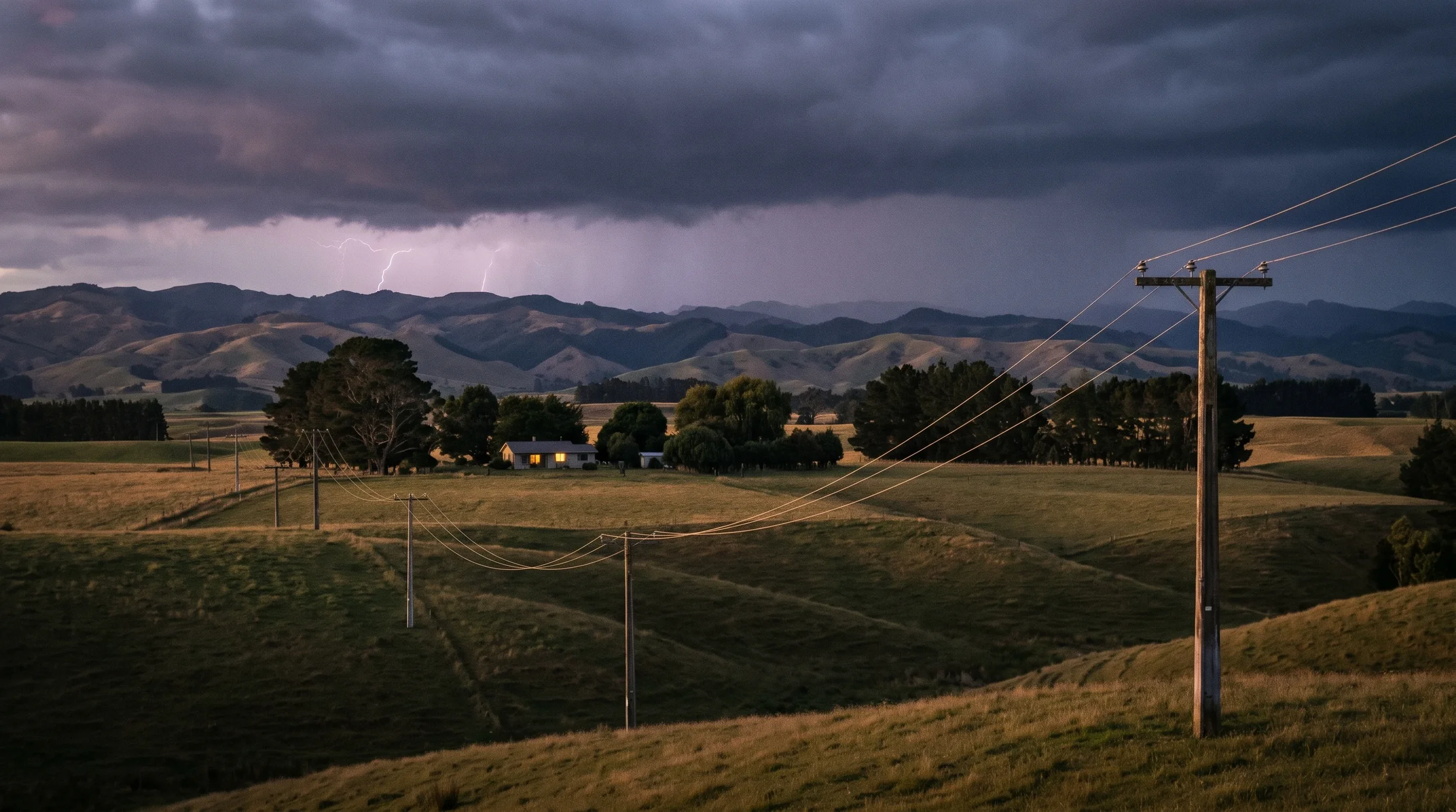
Properties at the end of long overhead lines, across the Moutere hills, out towards Golden Bay, or up valley roads, have more exposed line between them and the nearest substation. More exposed line means more opportunities for lightning and tree strikes to affect supply.
Rural homes also tend to run more motor-driven equipment, such as water pumps, effluent pumps and workshop machinery, which adds to internal switching surges. Weather-related outages are common in the district: at the end of December 2025, about 10,000 Tasman properties lost power after trees came down on lines.
Surge Protector vs Power Board: What's the Difference?
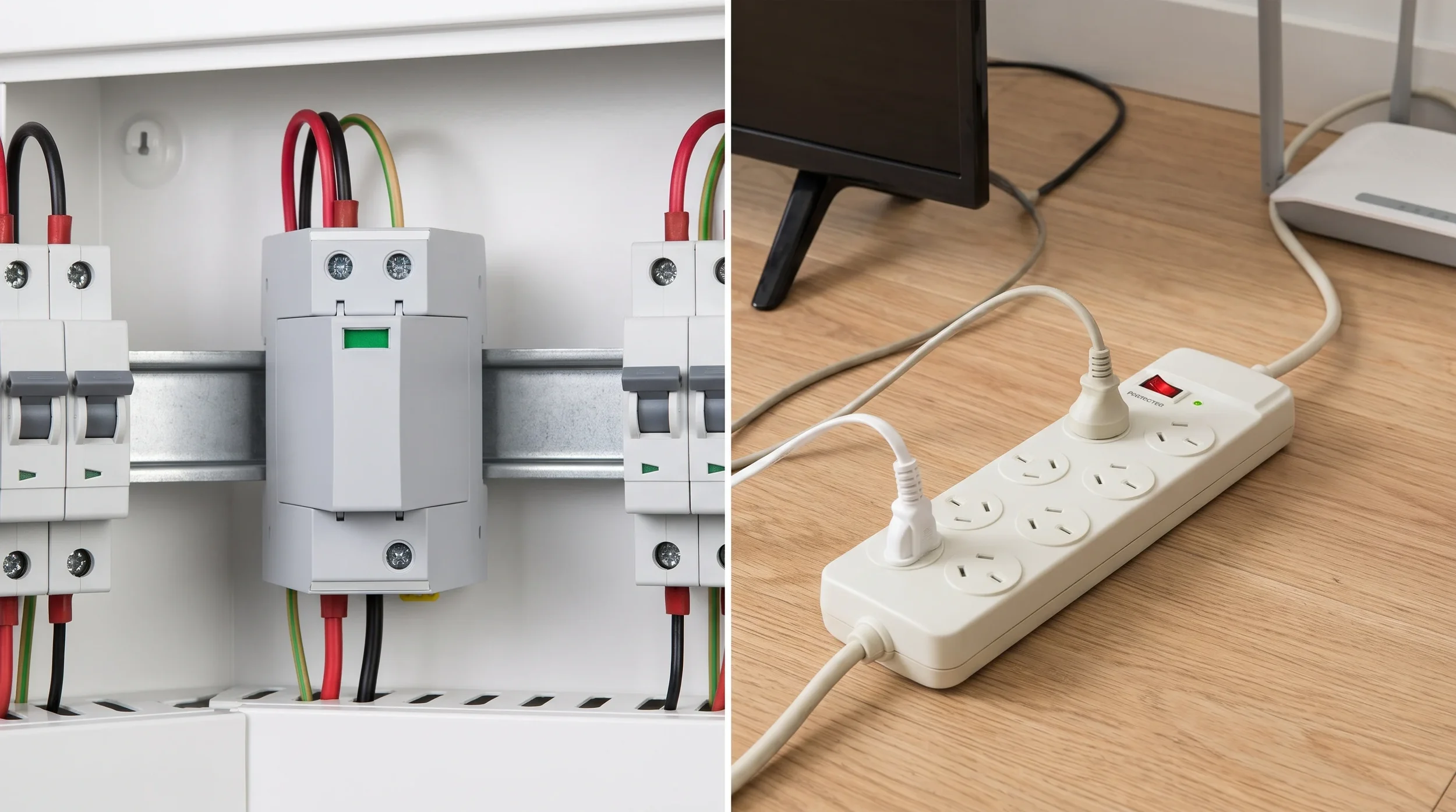
A switchboard surge diverter protects the whole electrical installation; a surge-protected power board only protects the devices plugged into it.
Here's how the main options compare:
| Feature | Switchboard surge diverter (Type 2) |
Surge-protected power board (Type 3) |
Plain power board |
|---|---|---|---|
| Where it sits | In the main switchboard | Plugged into a wall socket | Plugged into a wall socket |
| What it protects | Every circuit, including hardwired appliances and lighting | Only what is plugged into that board | Nothing — it only adds outlets |
| Surge capacity | Typically rated in kiloamps (kA), e.g. 40–100 kA per module | Rated in joules, often around 175–650 J on common NZ boards | None |
| Protects heat pump, oven, hot water controls? | Yes | No (these aren't plugged in) | No |
| Installation | Licensed electrician only | Plug in yourself | Plug in yourself |
| Typical NZ product cost | DIN-rail diverters from roughly $135 to $450 inc GST before labour | Roughly $20 to $85 | Under $20 |
| Shows when worn out? | Many models have a status flag or LED | Some have an indicator light | No |
The key point is coverage. Many of the most expensive electronics in a modern home are hardwired: heat pumps, induction cooktops, ovens, hot water cylinder controllers, ventilation systems, garage door motors, spa pool controllers and EV chargers. A power board can't reach any of them. A switchboard diverter can.
Power boards still have a job. They sit right beside sensitive electronics and catch the smaller spikes that get past the switchboard, which is why the best setups use both. Just don't plug one power board into another to get more outlets — our guide to the risks of daisy-chaining power leads explains why.
What a Surge Diverter Does and Doesn't Protect
This is the part most product packaging leaves out. A surge diverter is valuable, but it is one layer, not a force field.
What a switchboard surge diverter protects
Every circuit fed from that switchboard, including lighting, hardwired appliances and power points.
Appliances with electronic control boards, which are more sensitive to spikes than older resistive appliances.
Your wiring and switchgear, by limiting the voltage that reaches them during a supply-side surge.
What a switchboard surge diverter does not protect
A direct lightning strike to the house. No residential diverter can absorb the full energy of a direct strike. Structural lightning protection is a separate system.
Surges entering on other cables. Spikes can enter through copper phone lines, TV aerial or satellite coax, or long outdoor data cables. A mains diverter doesn't see these. Fibre is non-conductive, but the router and fibre terminal still run on mains power.
Sub-boards and outbuildings on long cable runs. A sheds, sleep-out or pump shed fed from a long underground or overhead cable may need its own protection.
Surges created downstream. A spike from a motor starting inside the house may not pass through the diverter at all.
Itself, forever. MOV-based diverters wear with each surge they absorb. A large event can use one up, which is why indicator flags matter.
In our experience at Mako Electrical, the most common gap we see is a home that relies on a few power boards in the lounge while the heat pump, oven and hot water controls have no surge protection at all.
A surge diverter also needs a sound earth to work, because the earth is where it sends the surge. On an older installation, checking the main earth and the MEN connection is part of doing the job properly.
Is Whole-House Surge Protection Worth It?
For most Nelson Tasman homes with modern appliances, a surge diverter is a low-cost addition, especially when it's fitted during a switchboard upgrade or other board work.
The case is strongest if your home has any of the following:
An overhead supply, or a rural property at the end of a long line
A heat pump, induction cooktop, or appliances with electronic controls
Solar panels, a home battery or an EV charger
A spa pool, water pump or other motor-driven equipment
A home office or expensive AV equipment
The case is weaker in a small home with basic appliances on a short underground supply, but even then the cost of one replaced heat pump control board can exceed the cost of the diverter.
What does it cost?
Retail prices for single-phase DIN-rail surge diverters from NZ suppliers range from about $135 to around $450 including GST, depending on the surge rating and features such as status indicators or alarm contacts. Labour depends on whether there's a spare space in your switchboard and whether the board is in good enough condition to take new equipment.
Fitting a diverter to a modern board with spare room is usually a short job. If your board is full, has old ceramic fuses or doesn't have room for modern protection, it makes sense to look at the surge diverter as part of a switchboard upgrade for your Nelson Tasman home.
What about insurance and compensation?
Under the Consumer Guarantees Act, electricity supplied to homes must be of acceptable quality. Household claims for surge damage start with your electricity retailer, and Utilities Disputes can help if a claim isn't resolved. Retailers aren't liable for events outside anyone's control, such as natural disasters, so many weather-related claims end up with home contents insurance.
Either way, a claim takes time and paperwork. A surge diverter reduces the chance you need to make one.
How to Protect Appliances From Power Surges: A Layered Plan
The most reliable way to protect appliances from power surges is to combine switchboard protection, point-of-use protection and sensible habits.
Fit a surge diverter at the main switchboard. This covers every circuit, including hardwired appliances.
Add point-of-use protection for sensitive gear. Use a good-quality surge-protected power board for TVs, computers, modems and audio equipment.
Protect the other entry points. If you still use a copper phone line, aerial or satellite dish, use surge protection that covers those connections too.
Check the earth. Ask your electrician to confirm the main earth and MEN connection are in good condition.
Check the indicator after big storms. If your diverter has a status flag or LED, look at it after a major lightning event.
Keep the basics going. Unplugging sensitive electronics during a severe storm still helps. Our earlier article on protecting your home from power surges and lightning damage covers these everyday steps.
What We Check Before Fitting a Surge Diverter
When Jordan assesses a home for surge protection, the diverter itself is the easy part. The checks around it are what make it work.
Switchboard space and condition. Is there room for the module and its protective device, and is the board safe to work on?
The earthing system. A diverter can only send a surge to earth if the earth is sound.
What's hardwired. Heat pumps, ovens, hot water controls, spa pools and pumps help decide the surge rating needed.
Sub-boards and outbuildings. Sheds and sleep-outs on long cable runs may need their own protection.
Solar and EV equipment. These systems can have their own surge protection requirements, which need to work alongside the main board.
If you live in an older home, surge protection often sits alongside other upgrades. Our list of the top electrical safety upgrades for older Nelson Tasman homes shows where it fits among RCDs, wiring and outlets.
Common Mistakes to Avoid
Assuming your RCD covers surges. RCDs protect people from electric shock. They don't respond to voltage spikes. We explain the difference in what RCD protection does and doesn't cover.
Relying on power boards for hardwired appliances. A board in the lounge does nothing for the heat pump on the wall.
Buying the cheapest board for expensive gear. Joule ratings vary widely between products.
Ignoring the indicator. A spent diverter looks like any other module unless you check its flag or light.
DIY installation. Fitting a diverter is switchboard work and must be done by a licensed electrician.
Get Surge Protection Sorted Before the Next Storm
If you're not sure whether your switchboard has surge protection, or whether it's still working, Mako Electrical can check it for you. Jordan will look at your board, your earthing and the appliances you want to protect, then give you a clear, honest quote. If your board needs more than a diverter, he'll explain your options in plain English.
Call 027 393 8335 or request a quote for a switchboard check and surge diverter.
Surge Diverter or Power Boards? Why Nelson Tasman Homes Need Both
Whole house surge protection in NZ homes isn't a replacement for surge-protected power boards. It's the layer that covers everything boards can't reach. For Nelson Tasman homes on exposed lines, or with heat pumps, solar, spa pools and smart appliances, a switchboard surge diverter is one of the most cost-effective protections you can add, especially when it's fitted during other switchboard work.
Frequently Asked Questions
-
The surge diverter itself typically retails from about $135 to $450 including GST, depending on its surge rating and features. Installation adds labour, and the total depends on whether your switchboard has a spare space and is in good condition. Fitting one during a switchboard upgrade is usually the most cost-effective approach.
-
Surge diverters aren't generally required in standard New Zealand homes, but the Wiring Rules (AS/NZS 3000) set out how they must be installed when they are fitted. Some equipment, such as solar inverter systems, may have its own surge protection requirements. A licensed electrician can confirm what applies to your installation.
-
No. A surge diverter is installed inside the switchboard, which is prescribed electrical work in New Zealand. It must be fitted by a licensed electrician, who will also check the earthing and confirm the device suits your switchboard. Plug-in surge-protected power boards are the only surge protection homeowners can install themselves.
-
There's no fixed lifespan. MOV-based diverters wear a little with every surge they absorb, and a large lightning-related surge can use one up in a single event. Many models have a status flag or LED that shows when the module needs replacing, so check it after major storms.
-
Yes, a switchboard surge diverter protects hardwired appliances like heat pumps, which can't be protected by a plug-in power board. It limits supply-side voltage spikes on the heat pump's circuit. It won't prevent damage from a direct lightning strike or from internal faults in the unit itself.
-
For sensitive electronics, yes. The switchboard diverter removes most of a supply-side surge, and a surge-protected board beside your TV, computer or modem catches the smaller residual spike. Using both is called layered or coordinated surge protection, and it gives the best result.
-
No. A residential surge diverter is designed for surges travelling along the supply lines, such as those caused by nearby strikes or network faults. A direct strike to a building carries far more energy than a diverter can handle. Structural lightning protection is a separate, specialist system.
-
It's a good time to consider it. Solar inverters, batteries and EV chargers contain sensitive electronics and are expensive to repair. Solar systems can also need surge protection on the DC side, which is separate from the main switchboard diverter. Your electrician can plan both together.
-
Under the Consumer Guarantees Act, household electricity must be of acceptable quality, so claims start with your electricity retailer. If it's unresolved, Utilities Disputes offers a free service. Retailers aren't liable for events beyond anyone's control, so storm damage often goes through home contents insurance instead.
-
Sometimes. It needs a spare space, a suitable protective device and a sound earth. Older boards with ceramic fuses, no spare room or deteriorating components usually need upgrading first. In that case, the surge diverter is best added as part of the new switchboard.
