
What Does a Residential Electrical Installation Include From Start to Finish?

The Problem With "Just Get an Electrician In"
Most homeowners only think about their home's wiring when something goes wrong, or when a new build or renovation forces the question. And when it does, the answers online are either too vague ("we'll sort your power and lights") or too technical to actually use. You're left not knowing what you're paying for, when inspections happen, or what a Certificate of Compliance even means for you.
That gap causes real problems. Homeowners get quotes they can't compare properly, because one electrician's "installation" might mean five stages of certified work and another's might mean two. Some sign off on work without knowing an inspection was ever meant to happen. Others find out too late that a document they needed for insurance, a mortgage, or a resale was never issued in the first place.
The honest truth is that none of this is complicated once someone actually walks you through it. It's just rarely explained clearly, because most electricians assume you already know how the process works.
A residential electrical installation in Nelson Tasman generally runs through five stages: planning and design, rough-in wiring, switchboard and connection work, fit-off (fittings, points, and switches), and final testing with Certificate of Compliance sign-off. A qualified, EWRB-registered electrician manages every stage and must issue a Certificate of Compliance (CoC) before the work is considered legally finished. The stage most homeowners get wrong? Assuming the job is "done" once the lights turn on — without ever seeing the CoC, which is the one document that proves the work is safe and legal.
Key Takeaways
A residential electrical installation runs through five stages: planning, rough-in, switchboard connection, fit-off, and testing with CoC sign-off.
The Certificate of Compliance is the step most homeowners overlook — it's the legal proof the work is safe, not just a formality.
Only an EWRB-registered electrician with a current practising licence can legally carry out and certify this work.
Rough-in wiring and switchboard work happen before linings go up; fit-off happens once walls are painted.
Planning your electrical layout early, before framing, avoids costly changes later.
What a Residential Electrical Installation Actually Is
A residential electrical installation is the full process of designing, wiring, connecting, and certifying the electrical system in a home — whether that's a brand-new build, a full rewire, or a major renovation. It covers everything from the switchboard that distributes power around your house, to every power point, light switch, and hardwired appliance connection inside it.
It's not one job. It's a sequence of stages, each one building on the last, each one needing to be signed off before the next can safely begin. Skip a step, or hire someone who cuts corners on one, and the risk shows up later — as a fire hazard, a failed inspection, or a headache when you try to sell the house and the paperwork isn't there.
What Are the Stages of a Residential Electrical Installation in NZ?
If you only read one section of this article, make it this one. Here are the stages, in order, the way Mako Electrical runs them on Nelson Tasman homes:
1. Planning and design. Your electrician works out where every switch, power point, light, and appliance connection needs to go, matched to the building plans and your day-to-day needs.
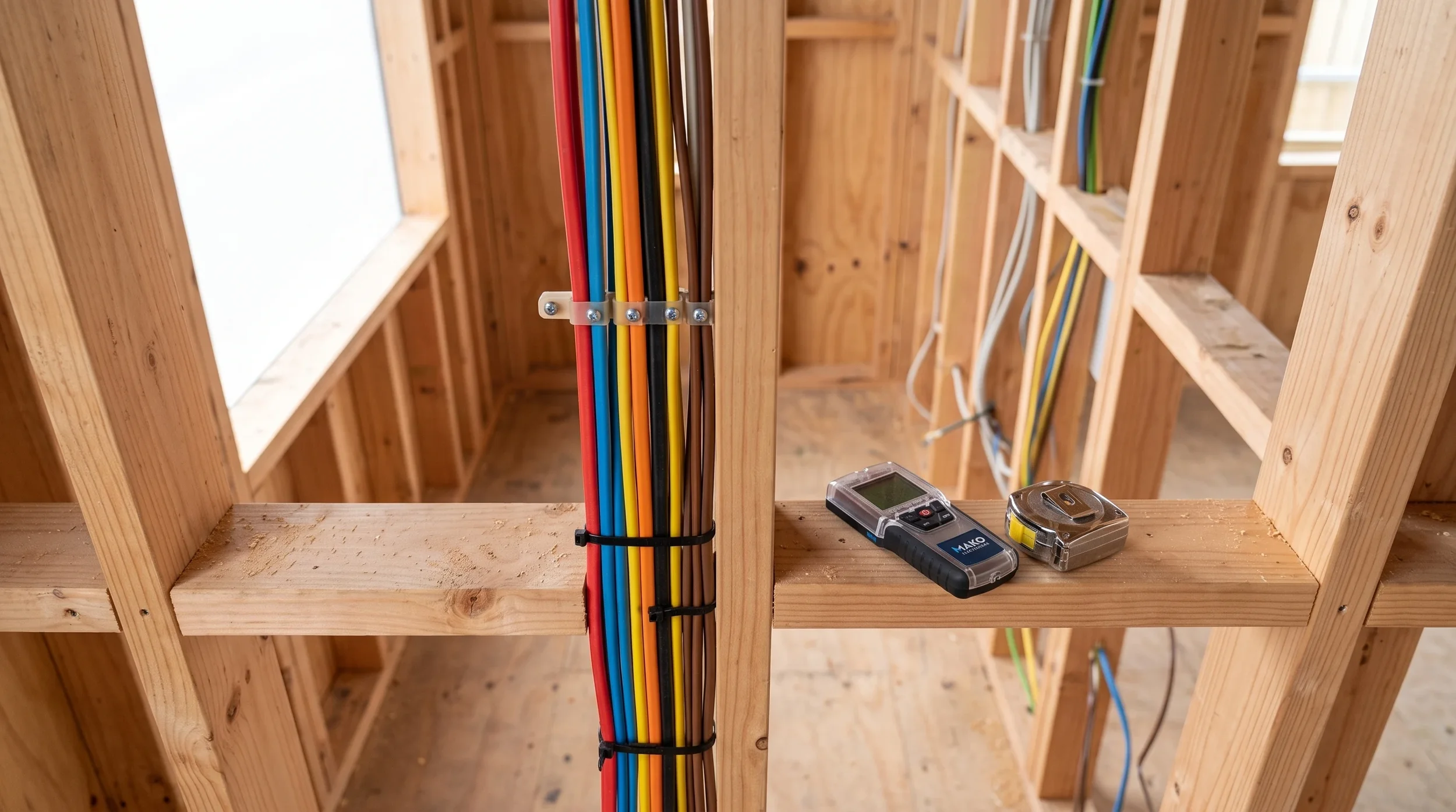
2. Rough-in wiring. Before the walls are lined, cabling is run through the framing to every fitting location, along with the initial switchboard groundwork.
3. Switchboard and mains connection. The switchboard is installed and connected to the incoming supply, with circuits, RCDs, and breakers set up to protect the whole home.
4. Fit-off. Once the walls are lined and painted, your electrician returns to fit the visible parts — power points, light switches, downlights, fans, and any smart home fittings.
5. Testing and Certificate of Compliance (CoC). Every circuit is tested against AS/NZS 3000 wiring rules during a formal electrical inspection, then your electrician issues a Certificate of Compliance, the legal record that the work is safe.
The stage most homeowners get wrong is the last one. Plenty of people assume that once the power's on and everything works, the job is finished. It isn't — not legally. Without a CoC on file, you have no proof the work meets New Zealand's wiring standards, and that catches people out at resale, insurance claims, or council inspection time far more often than it should.
Why This Matters More Than It Looks Like It Does
Here's the part that's easy to miss: every one of those five stages is also a safety checkpoint. Rushing rough-in wiring means cables can end up in the wrong place once the walls go up. A switchboard installed without the right RCD protection puts your family at risk every time it rains, or every time an appliance faults. And fit-off work done by someone unlicensed is one of the most common reasons New Zealand homes fail a pre-sale inspection.
This is exactly why the work has to be done — and signed off — by someone who's EWRB registered and holds a current practising licence. Every registered electrician in New Zealand has to renew that licence every two years through an EWRB-approved competency programme, which keeps their knowledge of AS/NZS 3000 wiring rules and the Electricity Act 1992 current. It's not a box-ticking exercise. It's the difference between wiring that's genuinely safe and wiring that just looks finished.
Common Mistakes Homeowners Make During an Installation
A few patterns show up again and again on Nelson Tasman homes, and most of them are avoidable with a bit of forward planning. The first is leaving electrical planning until after the framing is up, which forces cables into awkward routes or, worse, means switches and points end up in the wrong place entirely. The second is choosing whoever quotes the lowest price without checking they're actually EWRB registered — a decision that can leave you without a valid Certificate of Compliance at the end of it. The third is assuming "the electrician's finished" the moment the lights come on, rather than asking to see the CoC in writing.
None of these mistakes are about bad luck. They're about not knowing what to ask for, which is exactly the gap this guide is here to close.

Meet Your Electrician
Jordan Inwood is the fully qualified, EWRB-registered residential electrician behind Mako Electrical, working across Nelson and Tasman on new builds, renovations, and everyday home electrical jobs. Jordan set up Mako Electrical to bring straightforward, tidy, safety-first electrical work to local homeowners — the kind where you always know what stage your job is at and why.
Mako Electrical operates under the Master Electricians Terms of Trade, which sets out clear standards for workmanship, communication, and consumer protection. Combined with a current EWRB practising licence, that's the paper trail that should sit behind any residential electrical installation on your home. If you'd like a clearer picture of what to expect from that relationship day to day, this breakdown of what locals should expect from a residential electrician in Nelson Tasman covers it well.
A Typical New-Build Timeline: How the Stages Play Out on a Real Nelson Tasman Home
To make the five stages above less abstract, here's how they typically map onto a standard three-to-four-bedroom new build in the Nelson Tasman region. Every job differs slightly with weather, council scheduling, and how many other trades are on site, but this is a realistic shape for the process.

Notice the gap between rough-in and fit-off — that's normal. Your electrician isn't idle during that time; the home is waiting on linings, painting, and other trades before the visible fittings can go in. If your build's timeline looks similar, that's a good sign the process is running the way it should. For a closer look at how Mako sequences this against the rest of the build, see the step-by-step new build electrical design process.
The Real Benefits of Getting Every Stage Done Properly
When each stage is planned, wired, and signed off correctly, you get more than "the lights work." You get a switchboard sized for how you actually live — including future EV chargers or heat pumps — rather than one that's already maxed out on day one. You get power points placed where you'll actually use them, instead of guessed at. You get RCD protection that meets current standards, not whatever was code twenty years ago. And you get a Certificate of Compliance sitting in your files, ready the moment you need it for insurance, a bank valuation, or a sale.
None of that shows up if you go with whoever's cheapest and skips a stage to save time. It shows up years later, usually at the worst possible moment.
Planning Your Own Installation? Start Here
If you're planning a new build or a major renovation in Nelson Tasman, the best time to bring in an electrician is before the framing goes up, not after. Mako Electrical works directly with homeowners and builders to plan the electrical layout early, so rough-in wiring goes in the right place the first time. Not sure what to ask at that first meeting? This guide on what to ask your new build electrician before construction starts is a useful place to start.
Get in touch with Mako Electrical for a free, no-pressure quote on your residential electrical installation. You'll get a clear breakdown of each stage, realistic timing for your project, and a Certificate of Compliance you can actually rely on at the end of it. If you'd rather see the booking process laid out first, here's how to book a residential electrician in Nelson Tasman step by step.

Getting It Right, From the First Site Visit to the Final Sign-Off
A residential electrical installation isn't a single job you tick off — it's a sequence of stages that each protect the next, ending with a Certificate of Compliance that proves the whole thing was done properly. Understanding that sequence means you'll know exactly what to expect, what questions to ask, and what paperwork you should be holding once the last light switch clicks on.
If you're planning a new build, renovation, or rewire anywhere in Nelson Tasman, Mako Electrical is ready to walk you through every stage, start to finish.
Frequently Asked Questions
-
There are five main stages: planning and design, rough-in wiring, switchboard and mains connection, fit-off (fitting switches, points, and lights), and final testing with Certificate of Compliance sign-off. Each stage must be completed and often inspected before the next one starts, especially on new builds.
-
You don't usually need a building consent just for adding power points, but the work itself must be done by an EWRB-registered electrician and needs a Certificate of Compliance. Larger changes tied to a renovation may fall under your building consent, so check with your electrician first.
-
NZ home wiring must comply with AS/NZS 3000, the Electricity Act 1992, and current EWRB requirements. This covers correct RCD protection, safe circuit design, earthing, and proper testing before a Certificate of Compliance can be issued for any residential job.
-
Check they hold a current EWRB practising licence, ask for references or reviews from local jobs, and confirm they'll issue a Certificate of Compliance on completion. A licensed electrician should also explain each stage of your job clearly before starting.
-
Costs vary widely with layout, fittings, and whether it's a new build or renovation, so the only reliable figure is a site-specific quote. Our Nelson Tasman pricing guide breaks down what typically drives the price up or down.
-
Coastal Tasman homes benefit from wiring and fittings rated for higher humidity and salt exposure, particularly around switchboards and outdoor circuits. Your electrician should factor this into the design stage, not add it as an afterthought once fit-off begins.
-
Start with your appliance layout, benchtop plan, and any island bench, then map power points and switches around them before rough-in wiring begins. Getting this right at the planning stage avoids expensive rework once walls and cabinetry are in.
-
Your electrician tests every circuit against AS/NZS 3000 standards, checks RCD protection is working correctly, and confirms the installation matches what was planned. Once everything passes, they issue the Certificate of Compliance, the legal record of a safe installation.
-
A licensed, EWRB-registered electrician is accountable for the safety and legality of their work and must issue proper certification. A cheaper, unregistered option might save money upfront but leaves you without a Certificate of Compliance and no legal accountability if something goes wrong.
-
Smart switchboards, app-controlled lighting circuits, and EV charger pre-wiring are the most common energy-efficiency additions in new Nelson Tasman builds. See our comparison of standard versus smart switchboard upgrades if you're deciding which is worth it. It's far cheaper to plan for these during rough-in than to retrofit them after fit-off is complete.
